
iDeals vs Datasite: Which Data Room Wins? (2026)
iDeals and Datasite are both strong, quote-based enterprise data rooms. iDeals wins on usability and broad diligence, Datasite on full M&A deal lifecycle.

On this page
- iDeals vs Datasite at a glance
- Where iDeals is genuinely good
- Where Datasite is genuinely good
- The honest pricing reality for both
- The third option: Plox
- Original asset: the iDeals vs Datasite vs Plox decision framework
- One honest limitation
- How to actually decide in 10 minutes
- Frequently asked questions
- Is iDeals or Datasite better for M&A?
- Do iDeals and Datasite publish pricing?
- What is the cheapest alternative to iDeals and Datasite?
- Can I get a free trial of iDeals or Datasite?
- Which data room is easiest to use?
- Is Plox a real replacement for an enterprise VDR?
iDeals and Datasite are both quote-based enterprise virtual data rooms, and the choice between iDeals vs Datasite usually comes down to deal type. iDeals wins on usability and breadth across due diligence, while Datasite wins on end-to-end M&A deal lifecycle tooling for banks and advisors. Neither publishes prices or offers a free plan, so both require a sales call.
iDeals vs Datasite at a glance
Both tools sit in the enterprise tier of the virtual data room market. The honest summary: they are both genuinely good, and both are overkill (and overpriced) for a founder who just needs to share a deck and a diligence folder securely.
Here is how iDeals, Datasite, and Plox compare across the dimensions that actually decide a data room purchase.
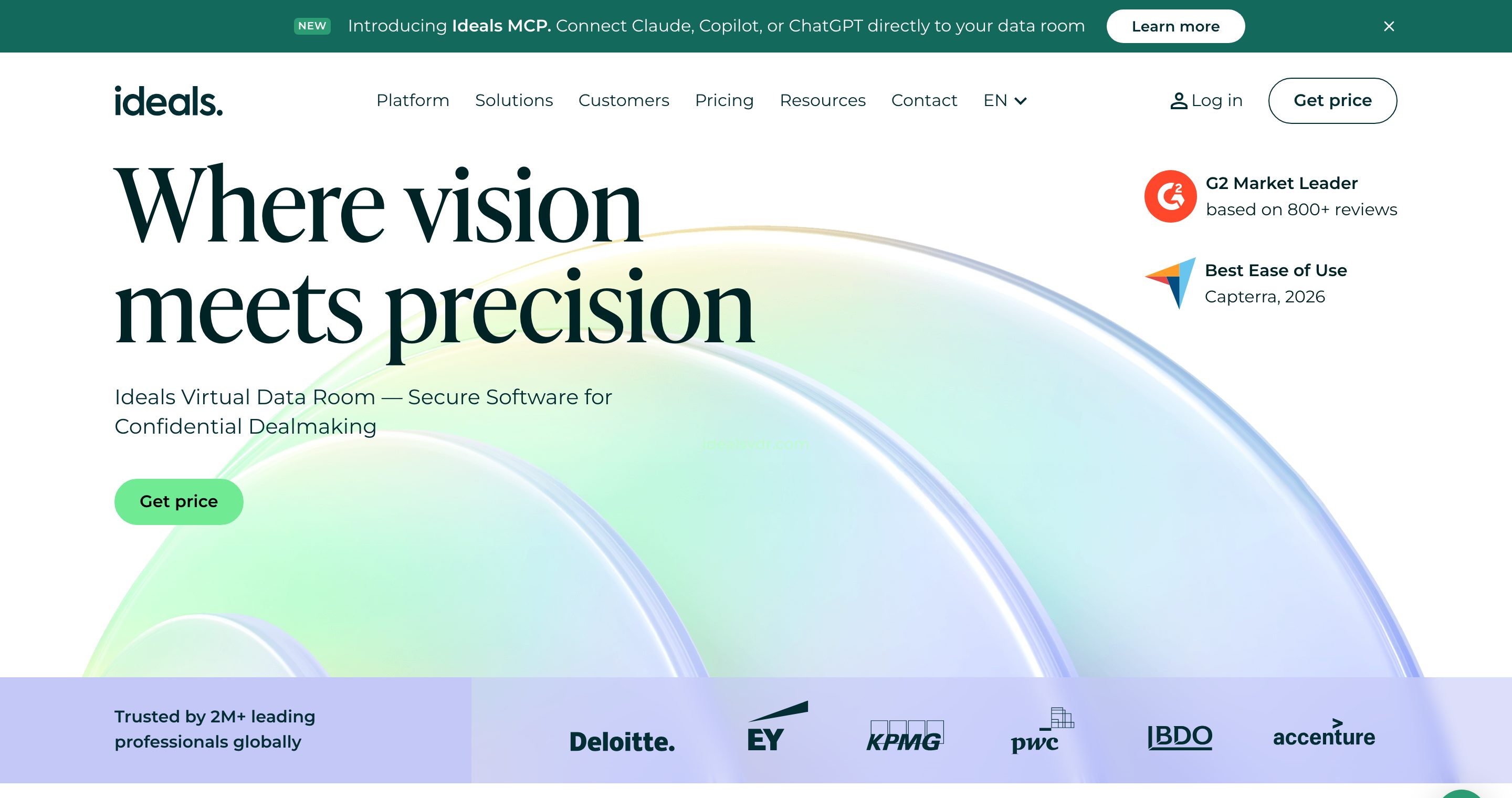

| Dimension | iDeals | Datasite | Plox |
|---|---|---|---|
| Pricing model | Quote-based, sales-gated [VERIFY PRICE] | Quote-based, often per project [VERIFY PRICE] | Flat, published, self-serve |
| Free plan | No | No | Yes, no card, no time limit |
| Ease of setup | Fast onboarding, easy admin UI | Powerful but heavier, geared to advisors | Live in minutes, no training |
| Permissions and Q&A | Granular roles, structured Q&A | Granular roles, advanced Q&A workflows | File-level permissions, visitor groups, Q&A |
| Analytics | Activity and audit reporting | Deal-level reporting and trackers | Page-by-page, time per page, completion %, real-time |
| Watermarking | Dynamic watermarking | Dynamic watermarking | Dynamic per-viewer watermark on every page |
| NDA / access gating | NDA and access controls | NDA and access controls | One-click NDA, passcodes, email verification, expiry |
| Support | Strong, 24/7 reputation | Strong, advisory-grade | Self-serve plus support, no mandatory sales call |
| AI | AI redaction and assist features | Generative AI tooling across the deal | Ploxie AI answers viewer questions from your docs |
| Best for | Broad diligence, ease of use | Bank-run M&A, full deal lifecycle | Founders and mid-market, self-serve raises and deals |
The pattern is clear. iDeals and Datasite are heavyweight, sales-gated platforms for advisory-grade transactions. Plox is the modern, founder-native option that starts free and scales into a real data room without a procurement cycle.
Where iDeals is genuinely good
Give credit where it is due. iDeals has built its reputation on usability. For a category known for clunky, dated interfaces, iDeals is consistently rated as one of the easier enterprise VDRs to learn and run.
A few real strengths:
- Onboarding speed: admins can stand up a room and structure folders without a long training program. That matters when a deal moves fast.
- Breadth of use: iDeals is used across M&A, fundraising, real estate, legal, and corporate diligence, not just one deal type. It is a generalist that does many diligence jobs well.
- Support reputation: 24/7 support and responsive account teams are a frequent theme in user reviews on sites like G2.
- Security depth: granular permissions, dynamic watermarking, and audit trails that satisfy serious diligence requirements.
If your priority is a capable enterprise room that your team can actually use without a manual, iDeals is a defensible choice. The catch is the same as every legacy VDR: you cannot see a price, you cannot start free, and you have to go through sales.
Where Datasite is genuinely good
Datasite earns its place differently. It is not just a data room, it is a platform for the whole M&A deal lifecycle. That is its real edge over a pure VDR.
Where Datasite stands out:
- Deal lifecycle tooling: beyond the room, Datasite offers deal sourcing, buyer marketing, and post-close integration tools. An advisor can run more of the transaction inside one platform.
- Built for banks and advisors: the workflows, reporting, and Q&A are designed for sell-side and buy-side mandates with many parties and tight process control.
- Scale and track record: Datasite has supported a very large volume of M&A transactions, and that operational maturity shows in complex, multi-party deals.
- Advanced AI: generative AI tooling to speed up document handling and analysis across large data sets.
If you are an investment bank, an M&A advisor, or a large corporate development team running a transaction big enough to justify the spend, Datasite is purpose-built for you. For a founder, most of that machinery is weight you will pay for and never use.
The honest pricing reality for both
Neither iDeals nor Datasite publishes pricing. Both are quote-based and sales-gated, which is standard for enterprise VDRs but frustrating if you just want to budget.
What that means in practice:
- No public rate card. Any number you find online is secondhand and may be stale. If a rep gives you a figure, treat it as [VERIFY PRICE] until it is in a contract.
- Cost is driven by variables, typically data volume, number of pages or documents, number of users, how long the room stays open, and add-on services like managed setup or redaction.
- Datasite is often priced per project, which fits advisory work billed per mandate but fits poorly when you need a room open for months during a raise.
- iDeals is typically annual or per-room, which can be more predictable but still requires a quote.
- No free plan on either. You cannot test the product before entering a sales process.
For a deeper breakdown, see our guides on iDeals data room pricing and Datasite pricing. Both walk through what drives the quote and what to ask before you sign.
The third option: Plox
There is a reason this comparison includes a third column. Most people searching iDeals vs Datasite are not investment banks. They are founders, operators, and lean deal teams who got pointed at enterprise VDRs and assumed that was the only serious option.
Plox is the self-serve alternative built for exactly that buyer. It is a secure document sharing platform and AI virtual data room, with a genuine free plan and flat, published pricing.
What you get without a sales call:
- Trackable secure links instead of attachments. The link never changes, and you can swap the file behind it anytime.
- Page-by-page analytics: who opened it, time spent per page, completion percentage, and a real-time notification the moment someone views.
- Document control: passcodes, email verification, one-click NDA, allow or deny download, link expiry, and instant revoke.
- Dynamic watermarking applied per viewer on every page, the same protection the enterprise tools charge a quote for.
- AI data rooms: folders, metrics blocks, video, and branding, with Ploxie AI answering viewer questions directly from your documents.
The free plan includes secure links, analytics, and real-time notifications with no credit card and no time limit. Paid tiers add watermarking, data rooms, branding, and advanced security, and there is a 14-day Data Rooms trial so you can test the full workflow before paying. Pricing is flat and self-serve, so you read the page and start, no procurement cycle.
The contrast is simple. iDeals and Datasite sell quoted, sales-gated software to advisors and enterprises. Plox sells modern, flat-priced software to the founders and mid-market teams running their own raises and deals.
Original asset: the iDeals vs Datasite vs Plox decision framework
Forget feature lists for a second. The right choice falls out of two questions: how big is the deal, and who is the buyer. Use this framework.
Choose iDeals if:
- You are running broad due diligence (M&A, real estate, legal, corporate) and want an enterprise room that is genuinely easy to administer.
- Ease of use and fast onboarding matter more to you than deal-sourcing or post-close tooling.
- Your deal or organization is large enough to absorb quote-based pricing, and you are fine going through sales.
- You value a strong 24/7 support relationship and want a generalist VDR that handles many diligence types well.
Choose Datasite if:
- You are an investment bank, M&A advisor, or large corporate development team running a transaction.
- You need the full deal lifecycle in one place: sourcing, buyer marketing, the room itself, and post-close integration.
- The deal is large enough that per-project, quote-based pricing is a rounding error against transaction value.
- Your process has many parties, tight control requirements, and a need for advisory-grade Q&A and reporting.
Choose Plox if:
- You are a founder, operator, or mid-market team and the deal is your own raise, sale, or diligence, not an advisory mandate.
- You want to start today, free, without a sales call or a quote.
- You need flat, predictable pricing you can read off a page and a room you can stand up in minutes.
- You want modern analytics (page-by-page, real-time), AI data rooms, and per-viewer watermarking without paying for tooling built for banks.
By deal size, the rough map looks like this:
- Sub-$50M founder-led raise or sale, or routine diligence: Plox. The enterprise tooling is weight you will not use.
- Mid-market deal run in-house by a busy team that still wants enterprise polish: Plox or iDeals, depending on whether you need a quoted enterprise contract or prefer flat self-serve.
- Large, advisor-run M&A with many parties and a full process: Datasite, with iDeals as the alternative if ease of use outranks lifecycle breadth.
The buyer type matters as much as the dollar amount. A $30M deal run by a five-person founding team is a Plox job. A $30M deal run by a bank inside a broader mandate may still be a Datasite or iDeals job because the advisor needs the process machinery.
One honest limitation
Plox is not the right tool for every transaction. If you are running a large, advisor-led M&A deal that needs deal sourcing, buyer marketing, post-close integration, and the kind of managed redaction and white-glove process control that banks expect, Datasite is purpose-built for that and Plox is not trying to be. Plox is the better fit for founders and mid-market teams who want secure sharing and a real AI data room without enterprise overhead, not for replicating a full investment-bank deal platform.
For a wider view of the category, see our guides to the best virtual data room for M&A and the broader set of tools on the data room comparison hub. You can also read our head-to-head pages on Plox vs iDeals and Plox vs Datasite.
How to actually decide in 10 minutes
If you want to short-circuit the analysis, run this:
- Is this an advisor-run deal or your own? Advisor-run leans Datasite or iDeals. Your own leans Plox.
- Do you need to test before you buy? If yes, only Plox lets you start free today. The other two require a sales process.
- Can you read your price off a page? If a flat, published number matters, Plox is the only one of the three that gives you one.
- Do you need deal-lifecycle tooling beyond the room? If yes, Datasite. If you just need a secure, analytics-rich room, Plox or iDeals.
- How much hand-holding do you want? Heavy managed services point to the enterprise tools. Self-serve points to Plox.
Most founders who run this end up testing Plox first because it costs nothing to try, then only moving to a quoted enterprise VDR if the deal genuinely demands it.
Frequently asked questions
Is iDeals or Datasite better for M&A?
For large, advisor-run M&A, Datasite has the edge because it covers the full deal lifecycle, including sourcing, buyer marketing, and post-close work, not just the data room. iDeals is excellent for broad due diligence and is easier to administer, so it suits teams that prioritize usability across many diligence types. Both are quote-based with no free plan.
Do iDeals and Datasite publish pricing?
No. Both are quote-based and sales-gated, which is normal for enterprise VDRs. You will not get a number without contacting their sales teams, and cost depends on data volume, users, deal duration, and add-on services. Treat any figure you are quoted as provisional until it is in a signed contract.
What is the cheapest alternative to iDeals and Datasite?
Plox is the most cost-predictable alternative because it has a genuine free plan and flat, published pricing. You can share secure trackable links with page-by-page analytics and real-time notifications at no cost, then move to paid tiers for watermarking, data rooms, and advanced security without a sales call.
Can I get a free trial of iDeals or Datasite?
Neither offers a published free plan, and free trials are arranged through their sales process rather than self-serve sign-up. If you want to test a data room today without talking to sales, Plox offers a free plan plus a 14-day Data Rooms trial that covers the full workflow.
Which data room is easiest to use?
Among the enterprise options, iDeals is widely rated as one of the easier VDRs to learn and administer. Datasite is powerful but heavier because it is built for advisors running full processes. Plox is the most self-serve of the three: you can stand up a room in minutes with no training and no onboarding call.
Is Plox a real replacement for an enterprise VDR?
For founders and mid-market teams, yes. Plox provides secure links, file-level permissions, visitor groups, Q&A, one-click NDA, dynamic per-viewer watermarking, and AI data rooms. For a large advisor-run M&A process that needs deal sourcing and post-close integration, an enterprise platform like Datasite is still the better fit, and Plox does not try to replace that.
Ready to skip the sales call? Start a free Plox data room and see who opens your documents, page by page, in real time. No credit card, no quote, live in minutes.
Written by the Plox team
Plox builds secure document sharing and virtual data room software for founders and dealmakers. We share pricing and comparisons transparently, and recheck competitor details regularly.