
iDeals Data Room Pricing: What It Costs and Is It Worth It?
iDeals does not publish fixed prices. Its data room pricing is quote-based and annual, driven by data, users, projects, and storage. Here is how the model.

On this page
- How iDeals data room pricing actually works
- What buyers report it ranges to
- What the quote model is actually optimised for
- What drives an iDeals quote up or down
- Is iDeals worth it?
- A worked example: the same deal, two ways
- iDeals vs Plox: pricing models compared
- An honest limitation
- The flat, self-serve alternative
- The bottom line
- Frequently asked questions
- How much does iDeals data room cost?
- Does iDeals have a free plan?
- Why is iDeals pricing not listed online?
- What makes iDeals VDR pricing go up?
- Is iDeals worth it for startups?
- What is a cheaper alternative to iDeals?
- How is Plox pricing different from iDeals?
iDeals data room pricing is custom and quote-based, not published on a page. Cost is set by a sales conversation and usually sold as an annual contract, driven by data volume, user seats, the number of projects or rooms, and storage. There is no free plan and no flat number, so you request a custom quote for your specific deal.
How iDeals data room pricing actually works
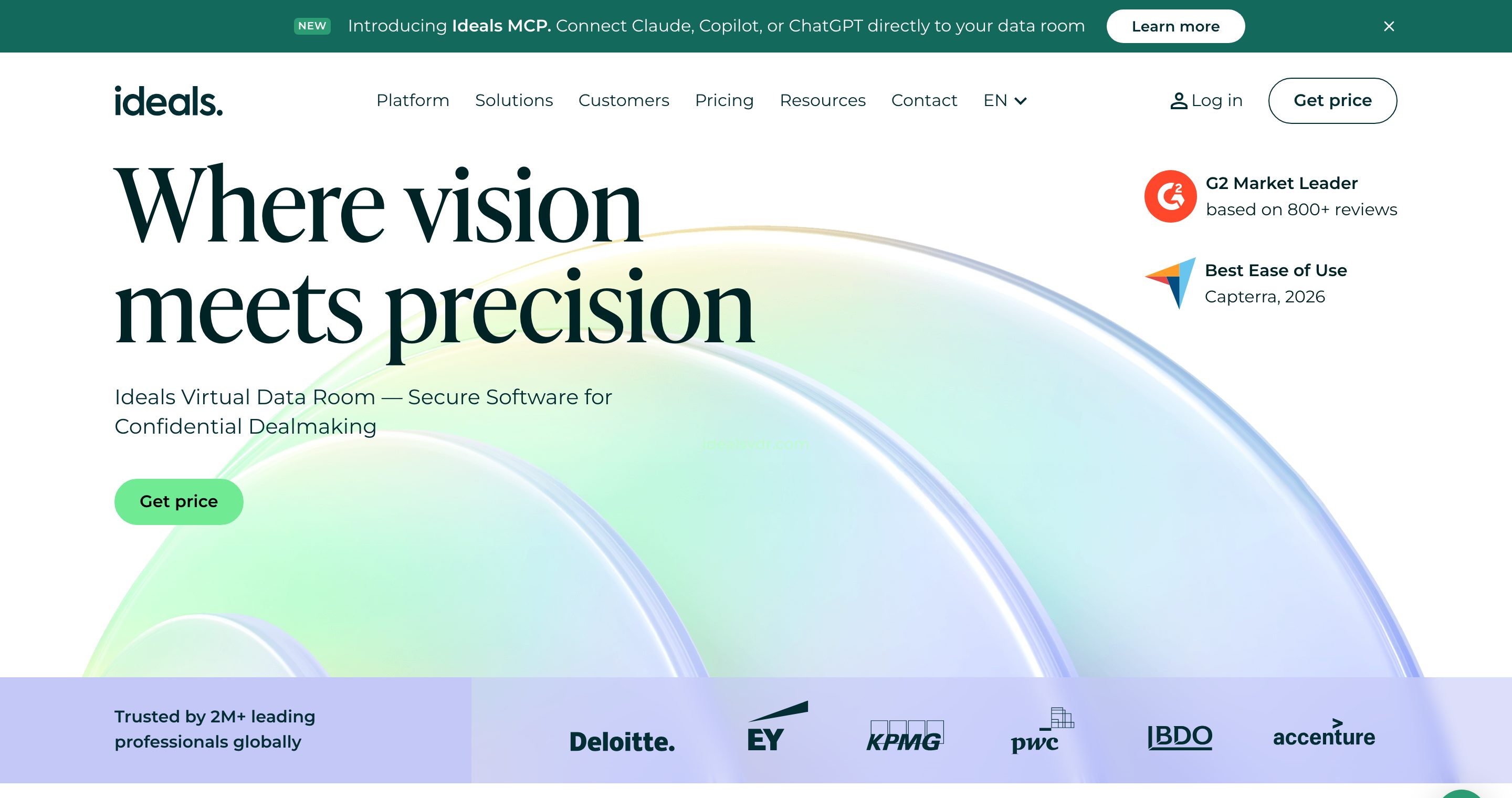
Unlike tools that list a number on a page, iDeals VDR pricing is built around a sales conversation. You tell them about your deal, and they build a quote. That means the headline question of "how much does iDeals cost" has no single published answer.
The quote is shaped by a few core levers:
- Data volume and storage: more gigabytes and more documents typically push the price up.
- Number of users or seats: larger admin and guest teams raise the cost.
- Number of projects or rooms: pricing is often scoped per project, so several concurrent deals cost more.
- Contract length: iDeals virtual data room cost is usually framed as an annual commitment rather than month to month.
- Add-ons: advanced security, dedicated support, and onboarding can sit in higher tiers.
Because these factors stack, two companies can pay very different amounts for what looks like the same product. A single seed-stage founder sharing one room with ten investors and a large corporate running a multi-bidder auction across several workstreams are quoted on completely different scales, even though the underlying software is the same.
What buyers report it ranges to
We will not invent a number here, and you should be skeptical of any article that does. The honest position, and the one iDeals itself takes, is that the figure is custom. What buyers consistently report is qualitative:
- iDeals is positioned as a premium, enterprise-grade virtual data room.
- M&A and due-diligence projects tend to land at the higher end of the market.
- Costs are commonly described as per project and annual, not a small monthly subscription.
- There is no free plan, though a time-limited trial is generally available.
If you need precise figures for budgeting, the honest answer is the same one iDeals gives: request a custom quote for your exact data, users, and project scope. For broader context on where enterprise rooms sit versus self-serve tools, see our guide to virtual data room cost.
What the quote model is actually optimised for
Quote-based pricing is not an accident or a tactic to hide a high number. It exists because enterprise procurement works that way. A corporate development team or an investment bank wants a contract that maps to a security review, a master services agreement, named support contacts, and a predictable annual line item. A published self-serve price does not fit that workflow.
So the model is optimised for the buyer who has a procurement process, not for the buyer who needs a room live this afternoon. That distinction, more than any specific dollar figure, is what should drive your decision.
What drives an iDeals quote up or down
If you are going to ask for a quote, it helps to know which levers you actually control. Use this as a pre-call checklist so the conversation is shorter and the number is tighter.
Copy-paste pre-quote checklist:
iDeals quote-prep checklist
[ ] Deal type (fundraise / M&A sell-side / M&A buy-side / audit / other)
[ ] Expected total data volume in GB (estimate high, you cannot easily downsize mid-contract)
[ ] Number of admin seats vs guest/viewer seats
[ ] Number of concurrent projects or rooms you need
[ ] Contract length you are willing to commit to (annual is standard)
[ ] Compliance requirements (ISO 27001, SOC 2, GDPR, HIPAA, specific data residency)
[ ] Must-have add-ons (dedicated PM, 24/7 support, custom branding, advanced redaction)
[ ] Timeline: when does the room need to be live?
[ ] Your walk-away budget and your realistic alternative (BATNA)
Two of these lines matter most. Data volume and number of projects are the biggest multipliers, so estimate them honestly. And the timeline line is the one that catches founders out: a quote-and-procurement cycle can run days to weeks, which is fine for a planned M&A process and painful when an investor asks for your data room today.
Is iDeals worth it?
Whether iDeals pricing is worth it depends entirely on who you are.
Enterprise and complex M&A: often yes. If you are running a large transaction with many bidders, strict compliance needs, and a deal team that expects white-glove support, the iDeals feature set and reputation can justify the spend. The cost is small relative to the transaction value. This is also where iDeals is genuinely good: its granular permissions, audit trails, redaction, and dedicated project management are built for exactly this kind of high-stakes, regulated process, and that is a real strength, not marketing. Frameworks like ISO/IEC 27001 exist precisely because enterprise buyers need this level of assurance, and iDeals is built to satisfy it.
Startups, founders, and smaller deals: you likely overpay. If you are a founder sharing a pitch deck, a financial model, and a cap table with investors, an annual enterprise contract priced by data and seats is usually far more than you need. You end up paying for procurement-grade scale and a sales-assisted setup when a simple link would do.
The mismatch is not about quality. It is about fit. Quote-based annual contracts are designed for predictable enterprise budgets, not for a founder who needs a room live this afternoon.
A worked example: the same deal, two ways
Take a founder raising a $3M seed round. She needs to share a pitch deck, a financial model, a cap table, and a folder of legal documents with about twelve investors over six weeks.
The iDeals path: book a call, scope data and seats, receive an annual quote, run it past procurement, sign, and onboard. The room is excellent once live, but the founder has committed to a year-long enterprise contract to support a six-week raise, and she waited on a sales cycle to get started.
The self-serve path: she uploads the same files, creates a room, sets a passcode and one-click NDA, turns on per-viewer watermarking, and sends a single link the same afternoon. She watches page-by-page analytics to see which investors actually opened the financial model and how long they spent on the cap table.
Both work. The question is whether the deal justifies an annual enterprise contract or whether flat, self-serve pricing covers it. For most seed and Series A raises, it does. See best virtual data room for M&A for where the calculus flips toward enterprise tools.
iDeals vs Plox: pricing models compared
The clearest way to see the difference is to compare the pricing models rather than guess at numbers. iDeals is custom and quote-based. Plox publishes flat pricing, offers a free plan, and lets you self-serve in minutes.
| Decision dimension | iDeals | Plox |
|---|---|---|
| Pricing model | Custom quote, annual | Flat, published |
| Free plan | No (time-limited trial only) | Yes, no credit card, no time limit |
| Billing driver | Data, users, projects, storage | Per seat, flat |
| Setup | Sales-assisted, procurement cycle | Self-serve in minutes |
| Page-by-page analytics | Audit logs | Yes on every plan, including Free |
| Dynamic watermarking | Yes (enterprise) | Yes, per-viewer on every page (paid) |
| One-click NDA | Yes | Yes |
| Data rooms with Q&A | Yes | Yes, with Ploxie AI answering from your docs |
| Compliance/support | Enterprise-grade, white-glove | Self-serve, lighter touch |
| Best for | Large regulated multi-bidder M&A | Founders, dealmakers, smaller and faster deals |
For a deeper feature-by-feature breakdown, see our Plox vs iDeals comparison. If you are also weighing other enterprise rooms, Intralinks pricing follows the same quote-based pattern, so the trade-offs are similar.
An honest limitation
To be fair on both sides: a flat self-serve tool is not always the right answer. If your deal genuinely requires a named project manager available around the clock, deep redaction at scale across thousands of documents, formal procurement-friendly contracting, or a specific compliance certification that your counterparty's legal team insists on, a sales-gated enterprise VDR like iDeals is built for that and a lighter self-serve tool may not clear the bar. Buy the tool that fits the deal, not the cheapest one on principle.
The flat, self-serve alternative
If the quote process feels heavy for your deal, the alternative is simple, published pricing with no sales call.
Plox gives you:
- Secure trackable links that recipients open without creating an account. The link never changes; you can update the underlying file anytime.
- Page-by-page analytics and real-time notifications on every plan, including Free, so you see exactly which pages a viewer read, for how long, and their completion percentage.
- Document control: passcodes, email verification, one-click NDA, allow or deny download, link expiry, and revoke access.
- Dynamic watermarking applied per viewer on every page on paid plans.
- Virtual data rooms with folders, branding, and Ploxie AI that answers viewer questions directly from your documents.
- A 14-day Data Rooms trial so you can run a real deal before committing.
For founders and dealmakers who want a virtual data room without an annual enterprise contract, Plox data rooms deliver the controls that matter at a price you can read off the page.
The bottom line
iDeals data room pricing is custom, quote-based, and usually annual, with cost driven by data, users, projects, and storage. There is no free plan and no published number, so you have to ask their sales team for a figure. That model fits large enterprises running high-stakes M&A, and iDeals is genuinely good at that job. For founders and smaller deals, flat self-serve pricing with analytics on every plan is usually the better value, and you can start today instead of waiting on a quote.
Ready to skip the sales call? Start free on Plox and have a secure, tracked room live this afternoon, then upgrade only if the deal needs it.
Frequently asked questions
How much does iDeals data room cost?
iDeals does not publish fixed prices. Cost is set by a custom quote based on your data volume, number of users, number of projects, and storage, and it is typically billed as an annual contract. Contact iDeals sales for an exact figure.
Does iDeals have a free plan?
No. iDeals does not offer a free plan. A time-limited trial is generally available, but ongoing use requires a paid, quote-based contract. Plox, by contrast, offers a genuine free plan plus a 14-day Data Rooms trial.
Why is iDeals pricing not listed online?
iDeals uses a sales-assisted, quote-based model aimed at enterprise buyers. Because the price depends on data, seats, projects, and contract terms, they build a custom quote per customer rather than publishing flat numbers.
What makes iDeals VDR pricing go up?
The main cost drivers are data volume and storage, the number of users or seats, the number of projects or rooms, contract length, and premium add-ons like advanced security and dedicated support.
Is iDeals worth it for startups?
For most startups and founders, an annual enterprise contract priced by data and users is more than the deal requires. A flat, self-serve data room with page-by-page analytics is usually a better fit and lets you start in minutes.
What is a cheaper alternative to iDeals?
Plox offers flat, published pricing, a free plan, and a 14-day Data Rooms trial. You get secure trackable links and page-by-page analytics on every plan, with data rooms, file-level permissions, Q&A, and NDA gating on the paid plans.
How is Plox pricing different from iDeals?
Plox publishes flat prices you can read off the page and bills per seat, while iDeals quotes custom annual contracts driven by data, users, and projects. Plox also includes a free plan and self-serve setup, whereas iDeals setup is sales-assisted.
Written by the Plox team
Plox builds secure document sharing and virtual data room software for founders and dealmakers. We share pricing and comparisons transparently, and recheck competitor details regularly.