
Datasite Pricing and Cost: A 2026 Breakdown
Datasite uses custom, quote-based pricing aimed at investment banks and advisors. Here is how Datasite prices its data rooms, what drives the cost, why.

On this page
- How Datasite prices its data rooms
- Per-project vs annual: which model you will be offered
- Who Datasite pricing suits
- Why startups usually overpay for Datasite
- A 60-second decision framework: do you actually need Datasite?
- The flat, self-serve alternative
- What the same job costs in practice
- Datasite vs Plox: pricing models compared
- An honest limitation
- Which one should you choose
- Frequently asked questions
- How much does Datasite cost?
- Does Datasite have a free plan?
- Why is Datasite pricing not listed online?
- What drives the cost of a Datasite data room?
- Is Datasite worth it for startups?
- What is a flat-priced alternative to Datasite?
- Can I try a data room before paying?
- How does Datasite pricing compare to Intralinks or iDeals?
Datasite pricing is quote-based, not published. There is no public price list and no free plan. You request a custom quote from Datasite sales, and the figure is usually structured per project or as a committed annual contract. Cost is driven by data volume, page or document counts, number of users, deal duration, and add-on services. Expect a sales conversation before any number.
How Datasite prices its data rooms
Datasite is enterprise M&A software built for investment banks, advisors, and corporate development teams running large transactions. Its pricing is quote-based, so the cost you pay depends on a conversation with their sales team, not a published rate card.
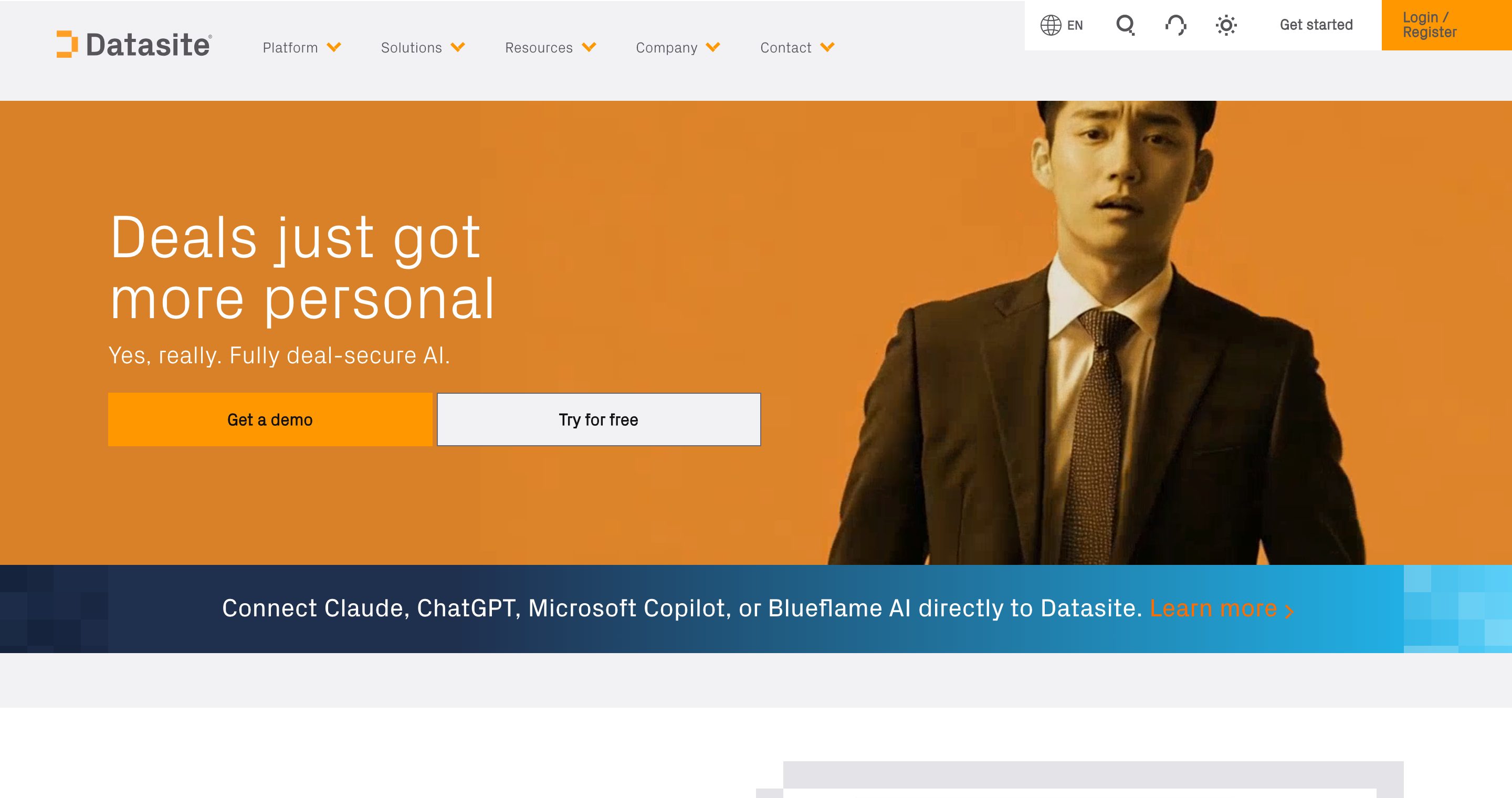
This is standard for the enterprise VDR category. Datasite, iDeals, Intralinks, Ansarada, and Firmex all sell through quotes rather than a public price page. The logic is that each transaction differs in size and scope, so the vendor scopes a contract to the specific deal. That works for a bank. It is friction for a founder who just wants to read a number and start.
Several factors typically drive a Datasite quote:
- Data volume: the amount of storage and the number of documents loaded into the room.
- Pages or per-project scope: many enterprise VDR contracts are structured around a single deal or project, sometimes with per-page components for large document sets.
- Users and seats: how many internal team members and external parties need access.
- Deal duration: how long the room stays open, since longer transactions consume more of the term.
- Add-on services: managed setup, document indexing, redaction, AI tooling, and dedicated support.
Because these variables move with each deal, two companies can receive very different quotes for what looks like the same software. That is normal for virtual data room pricing, but it makes budgeting hard if you just want to share documents securely.
Per-project vs annual: which model you will be offered
Datasite quotes tend to land in one of two shapes, and it helps to know which one you are being sold before you pick up the phone.
- Per-project: the room is scoped to a single transaction. This suits advisory work, where a sell-side mandate has a clear start and end and the cost is billed into the deal. The risk for a smaller team is that a "project" you thought would close in eight weeks drags to six months, and the term, the seats, and the add-ons all stretch with it.
- Committed annual: the room is a standing subscription, usually for teams that run multiple deals a year. This rewards volume but punishes the occasional user, because you commit to a year of spend for a process that might be live for one quarter.
There is no published figure for either model, so the only way to know your number is to enter the sales process. Treat that as a real cost: scoping calls, security reviews, and procurement cycles take time you may not have when a raise or a deal is moving.
Who Datasite pricing suits
Datasite is a strong fit when the deal itself justifies the spend and the process demands heavy support. It tends to make sense for:
- Investment banks and M&A advisors running sell-side or buy-side mandates. If you are in this group, the best data room for investment banks discussion is worth a closer read.
- Large corporate development teams managing complex, multi-party transactions.
- Regulated processes where managed services, redaction, and audit depth are required.
In those scenarios, the per-project model lines up with how advisory work is billed, and the cost is a small fraction of the transaction value. The quote, the onboarding, and the sales relationship are part of the package.
Here is the fair point, and it matters: Datasite is genuinely good at the high end. Its redaction tooling, managed services, and deal analytics are built for processes where a single mistake on a leaked document carries real legal weight, and a dedicated team owning your data room is a feature, not a cost. If you are running a $500M carve-out with twelve bidders, that machinery earns its quote. For that buyer, the lack of a free plan is irrelevant.
Why startups usually overpay for Datasite
The problem starts when a founder or small team adopts enterprise tooling for a job that does not need it. Common reasons startups overpay:
- Per-project pricing for ongoing needs: a startup sharing a deck, sending diligence files, or running a seed raise needs a room open for months at a time, not a one-off advisory project. Project-based contracts fit that poorly.
- Paying for services you will not use: managed indexing, redaction desks, and white-glove onboarding are valuable to a bank and irrelevant to a five-person team.
- No free tier to start: with no published free plan, you cannot test the product before committing to a sales process.
- Opaque budgeting: a custom quote makes it hard to predict spend, which is exactly what an early-stage team cannot afford.
For most founders, the core need is simple: send documents securely, control who sees what, and know who looked. You do not need a quote for that.
A 60-second decision framework: do you actually need Datasite?
Before you book a Datasite demo, run your situation through these five questions. Score one point for each "yes."
- Is this a single, time-boxed transaction (a sale, a carve-out, a syndicated raise) rather than ongoing document sharing?
- Will external advisors, lawyers, or bankers demand a named enterprise VDR by brand?
- Do you need managed services like a redaction desk or a vendor team loading and indexing documents for you?
- Is the deal large enough that a four- or five-figure quote is a rounding error against the transaction value?
- Is your process regulated to the point that you need vendor-level audit and compliance documentation?
4 to 5 points: a quote-based enterprise VDR like Datasite is a reasonable shortlist entry. Get competing quotes from Intralinks and iDeals too, since all are negotiable.
0 to 3 points: you are very likely overpaying. A flat, self-serve tool covers your real need at a predictable price, and you can start today without a call.
The flat, self-serve alternative
Plox is built for founders, startups, and mid-market teams who want secure document sharing and a real data room without a sales call. Pricing is flat and published, so you can read the page, pick a plan, and start in minutes.
Every Plox plan, including Free, includes:
- Secure trackable links for every document you share. The link never changes, and you can update the underlying file anytime.
- Page-by-page analytics, so you see exactly which pages each visitor viewed and for how long, plus completion percentage.
- Real-time notifications the moment someone opens your link.
As you move up, the higher tiers add the controls dealmakers expect. Pro adds more sharing power, custom branding, and a custom domain. Team adds dynamic watermarking applied per viewer on every page, screenshot protection, and one data room. The Data Rooms plan adds unlimited rooms, file-level permissions, visitor groups, Q&A, and one-click NDA gating, plus Ploxie AI that answers viewer questions directly from your documents. There is a 14-day Data Rooms trial so you can test the full workflow before you decide.
The contrast is straightforward: Datasite sells a quoted, project-scoped service to advisors, while Plox sells flat, self-serve software to the people running their own raises and deals.
What the same job costs in practice
Take a founder raising a Series A. The job is to share a deck and a diligence folder with fifteen investors over three months, see who actually read what, and gate the sensitive files behind an NDA.
With Datasite, that means a scoping call, a quote shaped around your data volume and term, and a contract before you send a single file. With a flat tool, you publish the room, send one link per investor, and watch page-by-page analytics roll in the same afternoon. Same outcome. One path has a sales cycle in front of it and one does not. For a deeper look at how the category prices overall, see our virtual data room cost breakdown.
Datasite vs Plox: pricing models compared
| Factor | Datasite | Plox |
|---|---|---|
| Pricing model | Custom quote, often per project | Flat, published |
| Free plan | No | Yes, no credit card, no time limit |
| Published prices | No public rate card | Full pricing on the page |
| Self-serve start | Sales plus onboarding | Sign up in minutes |
| Typical buyer | Investment banks, advisors | Founders, startups, mid-market |
| Analytics | Deal-level reporting | Page-by-page on every plan |
| Watermarking | Available, enterprise tier | Dynamic, per-viewer (Team and up) |
| One-click NDA | Via managed setup | Built in (Data Rooms plan) |
| AI in the data room | Add-on AI tooling | Ploxie AI answers viewer questions |
| Best for | Large, support-heavy transactions | Self-serve raises and deals |
For a deeper feature-by-feature look, see Plox vs Datasite.
An honest limitation
Plox is not the right tool for every Datasite buyer. If you are an M&A advisor running a regulated, multi-bidder process that requires a vendor-managed redaction desk, formal audit certifications negotiated into a contract, and a dedicated team loading thousands of documents on your behalf, an enterprise VDR with full managed services is built for exactly that, and Plox is not trying to replace it. Plox is self-serve software. It is the right call when the work is yours to run and the need is secure sharing, analytics, and a clean data room, not when you are outsourcing the entire deal-room operation to a vendor team.
Which one should you choose
Choose Datasite if you are an advisor or a large corporate team running a transaction big enough to absorb enterprise costs and you need managed services and a quoted, per-project contract.
Choose Plox if you are a founder or a lean team that wants secure, trackable document sharing and a data room you can stand up today, on flat pricing, with a free plan to start. You can move from reading the pricing page to sending your first tracked link in the same sitting, no quote required.
Frequently asked questions
How much does Datasite cost?
Datasite does not publish fixed prices. It provides custom quotes, often structured per project or as a committed annual contract. Your cost depends on data volume, pages, users, deal duration, and any add-on services, so you need to contact Datasite sales for a figure. Because it is enterprise software sold quote-by-quote, there is no public number to quote here, and you should treat any specific figure you see online as unverified.
Does Datasite have a free plan?
No. Datasite does not offer a published free plan or free self-serve tier. To evaluate it you go through a sales process. Plox, by contrast, offers a genuine free plan with no credit card and no time limit, plus a 14-day Data Rooms trial so you can test the full workflow.
Why is Datasite pricing not listed online?
Datasite is enterprise M&A software sold to banks and advisors, where deals vary widely in size and scope. Quote-based pricing lets their sales team scope each contract to the specific transaction, which is why there is no public rate card. The whole enterprise VDR category, including iDeals, Intralinks, Ansarada, and Firmex, works the same way.
What drives the cost of a Datasite data room?
Cost is typically driven by data volume, the number of pages or documents, the number of users, how long the room stays open, and add-on services such as managed setup, redaction, and dedicated support. Because all of these are negotiable, getting competing quotes from other enterprise vendors gives you leverage.
Is Datasite worth it for startups?
Usually not. Datasite is built for advisory M&A, so startups often pay for project-based contracts and managed services they do not need. A flat, self-serve tool like Plox covers secure sharing, data rooms, and analytics at a predictable price. The exception is a startup in the middle of a large, advisor-led transaction where the bankers require a named enterprise VDR.
What is a flat-priced alternative to Datasite?
Plox is a flat, published, self-serve alternative. It offers secure trackable links, page-by-page analytics, and real-time notifications on every plan, plus data rooms with file-level permissions, visitor groups, Q&A, and one-click NDA gating on its Data Rooms plan, and Ploxie AI to answer viewer questions from your documents.
Can I try a data room before paying?
With Plox, yes. You can start on the free plan and use the 14-day Data Rooms trial to test the full workflow. Datasite has no published free trial and requires a sales conversation to get started.
How does Datasite pricing compare to Intralinks or iDeals?
All three are quote-based with no public price list, so a direct number-to-number comparison is not possible without requesting quotes from each. They differ in managed-service depth, AI features, and contract structure rather than on a posted rate. For context on how the broader market is priced, the virtual data room cost guide breaks down the full range. As a general benchmark on why M&A processes invest in secure data rooms at all, Harvard Law School's Forum on Corporate Governance regularly covers due diligence practice.
Written by the Plox team
Plox builds secure document sharing and virtual data room software for founders and dealmakers. We share pricing and comparisons transparently, and recheck competitor details regularly.